Understanding
AI Governance

AI Governance — Module 1 of 4

Click to start

Learning objectives

“As someone new to AI governance, I want to understand key concepts, how AI governance differs from model risk management, and how ​ValidMind supports governance workflows.”


This first module is part of a four-part series:

AI Governance

Module 1 — Contents

Training is interactive — you explore ​ValidMind live. Try it!

, , SPACE , N — next slide     , , P , H — previous slide     ? — all keyboard shortcuts

What is AI governance?

Defining AI governance

AI governance is the organizational framework for directing and overseeing how AI is designed, deployed, and used. It sets:

 Policy and standards

 Accountability and decision rights

 Lifecycle controls

 Ongoing oversight

Unit of management

In AI governance, the primary unit of management is the AI system or AI use case — not the individual model.

Focuses on:

  • How AI is used
  • Impact on stakeholders
  • Organizational accountability

Applies to:

  • Model-based AI
  • Non-model AI systems
  • Automated decision systems

AI governance vs MRM

Parallel use cases

AI governance and model risk management (MRM) are parallel use cases — not subsets of each other.

Aspect AI Governance MRM
Unit of management AI system / use case Model
Objective Organizational oversight Technical risk control
Scope Broad — ethics, compliance Narrow — performance, validation

Relationship

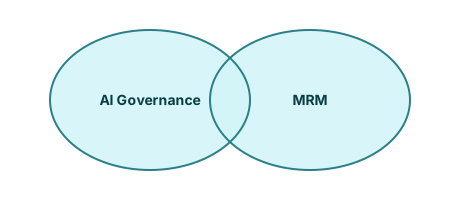
AI governance and MRM may also overlap with some shared artifacts:

  • Inventory
  • Approval workflows
  • Issue tracking
  • Ongoing monitoring

Diagram: AI Governance and MRM as overlapping circles with shared artifacts in the overlap.

Organizations can coordinate these use cases or manage them separately. ​ValidMind supports both approaches.

Key terminology

AI governance terms

Units of oversight:

  • AI system
  • AI application
  • AI use case
  • Automated decision system

Risk framing:

  • AI risk
  • Use case risk
  • Impact / harm
  • Ethical risk

Classification and lifecycle

Classification:

  • Risk tier
  • Impact level
  • Criticality
  • Prohibited / high-risk / limited-risk

Lifecycle:

  • Intake
  • Approval
  • Deployment
  • Human oversight
  • Retirement

Platform orientation

​ValidMind for AI governance

​ValidMind supports AI governance through:

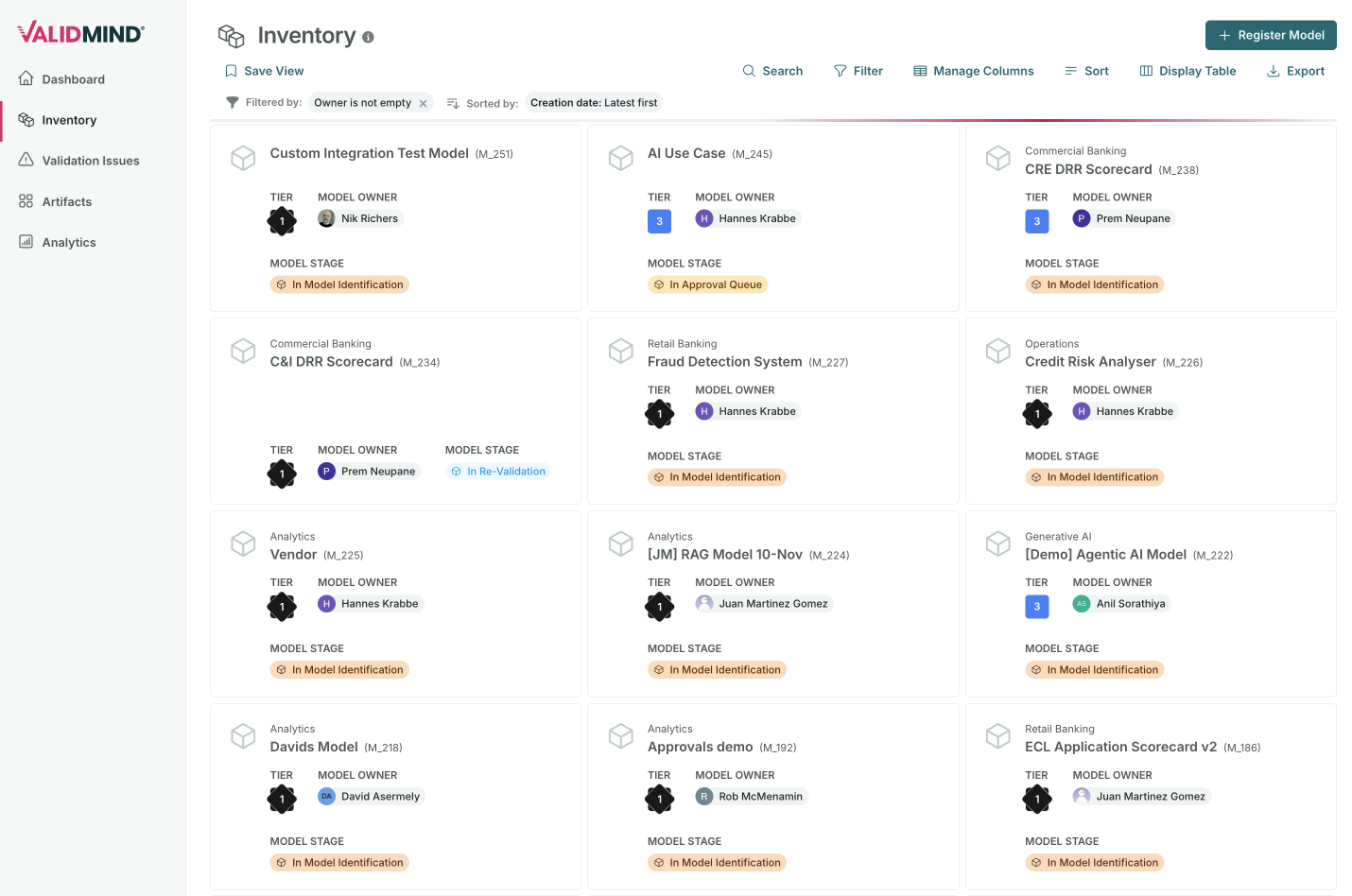
  • Inventory — Track AI systems use cases, owners, stakeholders, and more
  • Custom fields — Configure risk tiers, impact levels, and more
  • Workflows — Intake, approval, and lifecycle processes
  • Documentation — Run testing and generate documentation
  • Validation - Identify and track issues
  • Dashboards — Monitor compliance

A screenshot of the ValidMind Platform showing the main interface

The Inventory
  • Document Checker — Assess model documentation against regulations and internal policies
Next steps

Continue to Module 2 to learn about managing AI use cases in ​ValidMind.